Your Phoenix Moment: How IT Best Practices Can Transform FM Operations
What Facility Managers Can Learn from The Phoenix Project About Getting Out of Firefighting Mode
Maria's Monday
Maria is a facility manager, and her Monday starts before she even gets to her desk. Her phone already has 27 notifications — texts, emails, voicemails — with no way to tell what's urgent and what's noise.
By 9:30, she learns the HVAC is down in Building 3. She calls the vendor. The earliest they can come is Thursday. The forecast for Wednesday is 91 degrees.
At 11, someone tells her half the chairs are missing from the executive conference room. There's a board meeting at 2, and nobody knows where the chairs went.
Then her boss calls. He needs a maintenance spend report by the end of the day. The data lives in six spreadsheets, three portals, and Dave's head. Dave is on vacation.
She's busy all day, finishes none of her planned work, and tomorrow will probably look the same.
If that sounds like your Monday more often than you'd like, you're not alone — when this exact story was put to a room full of facility managers at FM Tech Week 2026, the vast majority said it hit close to home.
The IT industry had this exact crisis 15 years ago
Martin Byrne and Fawn Perazzo, co-founders of sonpito, opened their FM Tech Week session by pointing out something most FM professionals have never had reason to notice: IT went through this same firefighting spiral more than a decade ago, and it left behind a playbook.
In 2013, Gene Kim and his co-authors wrote The Phoenix Project, a novel about an IT manager named Bill Palmer who gets promoted into an organization that's completely drowning — unplanned work everywhere, no visibility, everything on fire. Bill's mentor, a manufacturing veteran named Erik, teaches him to see IT work the way you'd see a factory floor: map the flow, find the bottlenecks, make the work visible. It changed everything, and the book effectively launched the DevOps movement.
The parallels to facilities operations, Martin argued, are almost one to one:
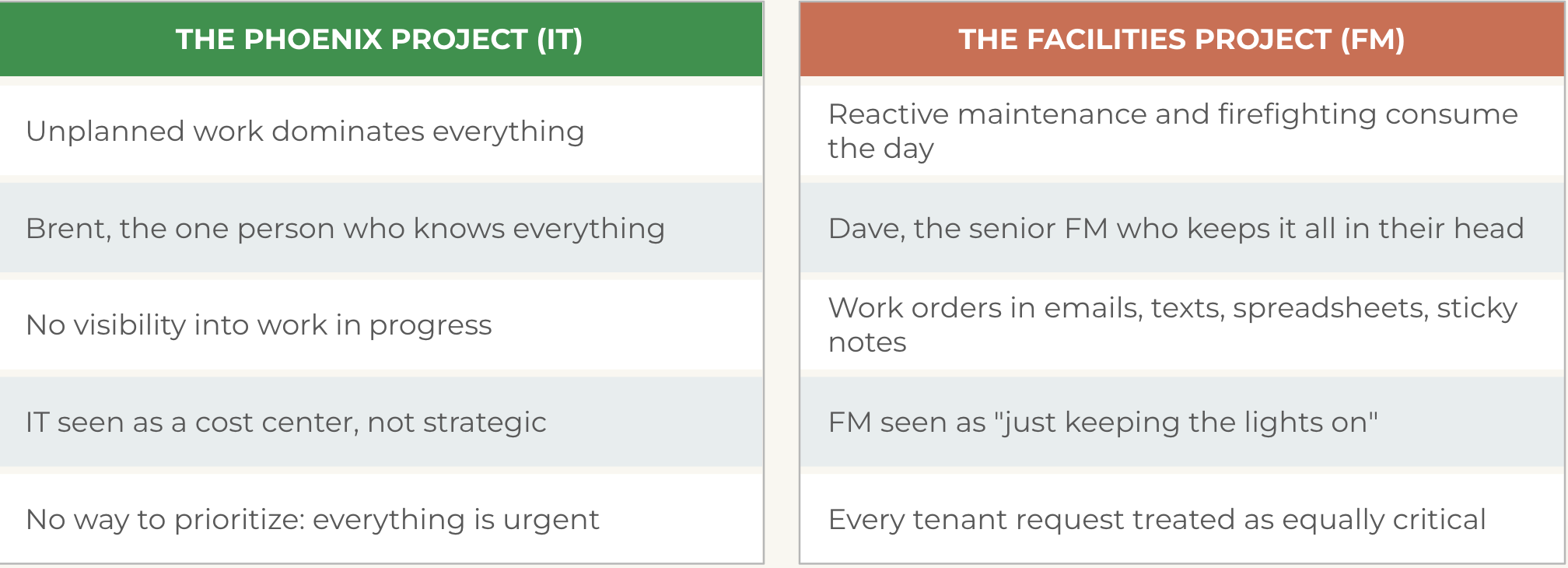
Bill Palmer didn't fix his organization by working harder. He fixed it by working differently, using a framework that's been around since the 1980s — one that most FM professionals have never heard of.
The Three Ways, in plain language
That framework is called the Three Ways, and it comes out of IT service management and lean manufacturing before that. Martin admitted that when he first explained it to Fawn using the IT terminology, she pushed back: "That's a lot of flowery IT jargon — don't you just mean capture the data, use the data, learn from the data?" Simply put, yes.
The First Way: Flow — capture the data. In the book, Bill Palmer's team puts every piece of work on a physical board and, for the first time, sees just how much work is actually in flight. It's staggering. They were drowning and didn't know it, because the work was invisible.
In FM, this means getting every work order, inspection, maintenance task, and vendor request into one system where it can be seen, prioritized, and tracked — no more "I texted the vendor" or "I think Sarah's handling that." Martin saw this firsthand running a real estate technology organization at a Fortune 500 tech company, where work lived across vendor emails, team inboxes, project trackers, and people's heads. Making it visible was step one, and it was harder than expected, because the culture rewarded looking busy, not being efficient.
The Second Way: Feedback — use the data. In IT, this meant building monitoring so a developer knew within minutes, not months, when a deployment broke something. In FM, it means closing the loop on work orders and tracking asset performance so your HVAC system tells you it's degrading before it fails on the hottest day of the year. It means knowing which vendors are actually meeting their SLAs, backed by data instead of gut feel. Fawn pointed to a real example: a major tech company with global vendor agreements worth millions of dollars had no structured way to measure SLA performance. The contracts were written for procurement, not operations — the feedback loop simply didn't exist.
The Third Way: Continuous Learning — learn from the data. In IT, this was the cultural shift toward blameless postmortems and experimentation instead of blame. In FM, it's the hardest of the three, and it's where Fawn's background in corporate real estate is most relevant. The culture she encountered moving from IT into CRE was fundamentally different: little executive sponsorship for operational excellence, capex growth dominating the agenda over operating efficiency, and local teams treating process improvement as a threat rather than an opportunity. The default answer to any problem was "that's the vendor's issue." This Way requires psychological safety and executive buy-in — but it starts with having the data to show what's working, which loops back to the first two Ways. You can't improve what you can't measure.
The four types of work — and the one that's killing you
There's one more idea from The Phoenix Project that Martin called impossible to unsee once you've seen it: all work falls into four categories, and it maps directly onto FM.
Planned projects — renovations, buildouts, sustainability retrofits. The big-ticket items leadership pays attention to.
Internal operations — preventive maintenance, inspections, safety audits. Essential, unglamorous, and the first thing pushed aside when something catches fire.
Changes and updates — vendor rotations, system upgrades, new tenant onboarding. They look manageable but create downstream ripple effects nobody anticipated.
Unplanned work — pipe bursts, HVAC failures, security incidents. The most expensive category, not because the tasks themselves cost more, but because every hour spent firefighting is an hour not spent on the preventive maintenance that would have prevented the next fire.
Industry surveys consistently show reactive organizations spend 60–65% of their time on unplanned work, against a best-practice target of 20%. When the session put that question to the audience live, 86% said unplanned work eats the bulk of their time — worse than even Fawn and Martin expected. Until you can see and measure all four types of work, unplanned work will always win.
Same building, same team, same budget — six months later
Fawn walked the audience through what changes when this framework is actually put into practice:
Before: 27 notifications and zero clarity on what's happening. After: Maria starts her Monday with a dashboard, not a crisis.
Before: No asset data, no way to push back on underperforming vendors. After: Her HVAC system flagged a problem eight days in advance, and maintenance was already scheduled.
Before: Three-plus hours to build a single manual report. After: Her boss pulls his own data from live dashboards and stopped asking her for reports.
Before: 86% reactive, nothing planned ever got done. After: Unplanned work is down 30%.
Before: Still at her desk at 6:47pm. After: Home by 5:30 on Friday, with everyone else.
She didn't get a bigger budget. She didn't hire more people. She changed how work works.
Fawn then walked through what that actually looks like inside sonpito — an urgent service ticket for a hot executive conference room getting logged and tied to the asset in seconds (Flow); pulling up that asset's history to find an overdue preventive maintenance task that likely caused the failure (Feedback); and zooming out to a portfolio-wide dashboard showing 36 other overdue PM work orders before they turn into the next emergency (Learning). Every overdue PM you can see is a future emergency you can still cancel.
You don't need to be ITIL certified
As Martin put it to close the session: you don't need to be ITIL certified to benefit from these principles, and you don't need executive sponsorship to start, though it helps. You need three things — visibility into your work, feedback loops that tell you what's working, and the willingness to improve one thing at a time, not everything at once.
The IT industry spent 20 years learning these lessons the hard way. FM teams don't have to.
Want to see the full session? Fawn and Martin walk through Maria's entire transformation live, including a real demo of the platform inside Salesforce. Watch the full FM Tech Week 2026 session, "Your Phoenix Moment: How IT Best Practices Can Transform FM Operations":
🎥 ▶️ Watch the full session
Session Resources:
The Phoenix Project Website
The Phoenix Project Readers Guide